

Email List Segmentation with AI – 7 Powerful Ways to Boost Engagement and Conversions
Discover 7 powerful ways to use Email List Segmentation with AI to increase engagement, personalize campaigns, and maximize conversions in your email marketing.
Email List Segmentation with AI is transforming the world of digital marketing. Instead of sending the same email to every subscriber, businesses can now use Artificial Intelligence to personalize messages based on each user’s behavior, interests, and buying patterns.
This data-driven approach leads to higher open rates, better customer engagement, and increased sales — all while saving marketers hours of manual work.
In this article, you’ll learn how to master Email List Segmentation with AI, discover its key benefits, explore real-world examples, and get actionable tips to implement AI-driven segmentation effectively.
1. What Is Email List Segmentation with AI?

At its core, Email List Segmentation with AI means using machine learning algorithms to divide your email subscribers into specific, data-based groups.
Traditional segmentation might rely on simple factors like age, gender, or location. But AI takes it several steps further. It analyzes patterns in user behavior — like which links subscribers click, what time they open emails, and what products they view — to predict what content they’re most likely to respond to.
For example:
- AI can segment users who browse product pages but never purchase.
- It can identify those who open every newsletter but ignore promotions.
- It can find customers who are ready to buy again based on their past actions.
You can read more about the basics of AI email personalization on Mailchimp’s blog (DoFollow).
2. Why Email List Segmentation with AI Matters
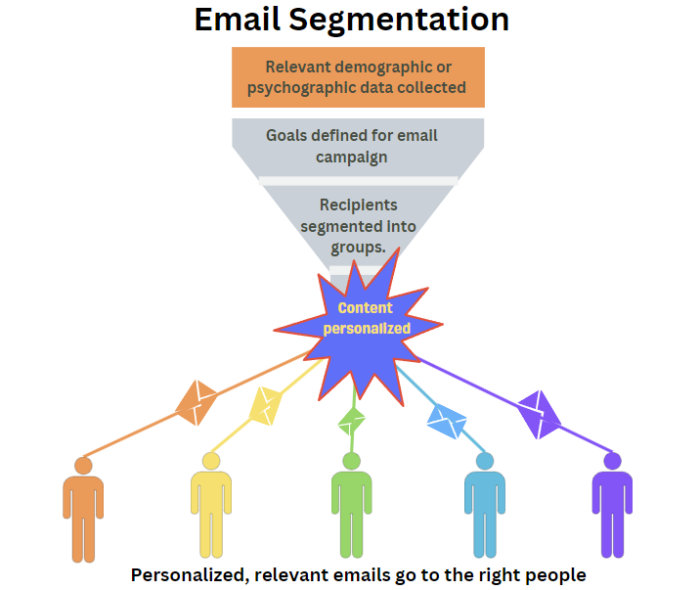
Segmentation has always been a core part of email marketing, but AI makes it smarter, faster, and more accurate.
According to studies, segmented email campaigns generate up to 760% more revenue than non-segmented ones. AI ensures that segmentation is dynamic — updating in real time as customer behavior changes.
Key benefits:
- Your campaigns become highly relevant to every subscriber.
- You save time through automated list updates.
- You achieve higher engagement with less manual effort.
If you’re already using automation tools, learn how AI improves them further in our article on AI Marketing Automation Tools (internal link).
3. How AI Improves Email Segmentation Accuracy
A. Behavioral Analysis
AI studies subscriber behavior — email clicks, browsing activity, purchase history — and groups users with similar patterns. For instance, people who repeatedly view “productivity tools” can receive targeted offers in that category.
B. Predictive Analytics
Using past data, AI can predict future actions. It can tell which users are likely to buy, which are about to churn, and who needs re-engagement. Predictive segmentation lets marketers target the right audience before they even act.
C. Sentiment Analysis
AI-powered tools analyze tone and language in replies or social media messages. If a user expresses dissatisfaction, AI can segment them for recovery or retention campaigns.
For a deeper understanding, explore Salesforce’s AI in Marketing Insights (DoFollow).
4. Benefits of Email List Segmentation with AI
1. Hyper-Personalized Campaigns
AI tailors each email to match a subscriber’s exact interests. Subject lines, product recommendations, and even visuals can change automatically based on individual behavior.
2. Improved Engagement
AI determines when your audience is most active and sends emails at the optimal time. This increases open rates, click-throughs, and conversions.
3. Increased Revenue
Targeted campaigns lead to better results. By delivering personalized offers to high-intent customers, you directly boost your sales and ROI.
4. Reduced Churn
AI can detect disengaged subscribers early and trigger re-engagement emails before they unsubscribe.
5. Smarter Data Insights
AI tools like HubSpot and Klaviyo provide dashboards that reveal what’s working, what’s not, and how to improve segmentation strategies.
5. Real-World Examples of AI-Driven Email Segmentation
E-commerce Success
Amazon and Shopify stores use AI to recommend products based on user behavior. A customer who buys running shoes might automatically receive offers for athletic wear or fitness gadgets.
Media and Newsletters
News outlets like The New York Times use AI to analyze reading preferences and deliver tailored content to subscribers who prefer certain topics — such as tech, finance, or lifestyle.
SaaS Companies
Software companies segment users by product usage and send personalized onboarding tips or upgrade offers based on how customers interact with their tools.
Learn more from Forbes’ report on AI in Marketing (DoFollow).
6. How to Implement Email List Segmentation with AI
Step 1: Choose the Right AI-Powered Email Platform
Popular tools like HubSpot, ActiveCampaign, and Klaviyo have built-in AI segmentation features. Select one that integrates easily with your CRM and analytics.
Step 2: Collect and Clean Your Data
AI relies on quality data. Ensure your contact lists are updated and duplicate entries removed before launching segmentation.
Step 3: Define Segmentation Goals
Ask yourself:
- What do I want to achieve (more sales, engagement, re-engagement)?
- Which behaviors should trigger segmentation (cart abandonment, inactivity, past purchases)?
Step 4: Train and Test Your AI System
Feed the AI tool with data and monitor how it classifies users. Adjust parameters for improved accuracy.
Step 5: Automate and Analyze
Once your AI model is running, set it to automatically segment new subscribers. Review performance monthly and fine-tune your campaigns.
7. Best Practices for Email List Segmentation with AI
- Keep it Human – AI enhances personalization, but don’t lose the human tone in your messages.
- Test Regularly – A/B test segments and subject lines to identify what works best.
- Protect Data Privacy – Always comply with GDPR and local data protection laws.
- Integrate Across Channels – Connect AI email segmentation with SMS, push notifications, and social ads for consistent messaging.
- Start Small – Begin with simple automation like segmenting by engagement, then expand to predictive and behavioral data.
8. Future of Email List Segmentation with AI
AI will continue to evolve, enabling even deeper personalization. Expect to see:
- Real-time content generation using generative AI.
- Emotional targeting that adapts tone based on user sentiment.
- Predictive campaign design where AI chooses the best visuals, timing, and offers automatically.
Brands that embrace Email List Segmentation with AI today will be far ahead of the competition in the coming years.
FAQs About Email List Segmentation with AI
1. What is the main purpose of Email List Segmentation with AI?
It helps marketers send relevant, personalized emails by grouping subscribers based on behavior and preferences using Artificial Intelligence.
2. Is it difficult to implement?
No. Modern email marketing tools like Mailchimp and HubSpot make AI segmentation easy with built-in automation and predictive analytics.
3. Does AI segmentation work for small businesses?
Absolutely. Even small subscriber lists benefit from personalized, automated engagement — improving conversions and customer loyalty.
4. What’s the average ROI improvement?
Businesses using AI-based segmentation report up to 40–60% higher engagement rates and 20–30% increased revenue.
5. Will AI replace human marketers?
No — it enhances marketing by handling data analysis, allowing humans to focus on creativity and strategy.
Conclusion
Email List Segmentation with AI is no longer a luxury — it’s a necessity for modern marketers. AI helps you understand your audience deeply, personalize every message, and build meaningful customer relationships that last.
By implementing these seven powerful strategies, you’ll not only improve engagement and conversions but also future-proof your marketing campaigns against changing consumer behaviors.
Start today — embrace Email List Segmentation with AI and watch your marketing results soar.

I don’t think the title of your article matches the content lol. Just kidding, mainly because I had some doubts after reading the article.
Не могу не написать, очень качественно изложено!
Can you be more specific about the content of your article? After reading it, I still have some doubts. Hope you can help me. https://accounts.binance.com/fr-AF/register-person?ref=JHQQKNKN
Your point of view caught my eye and was very interesting. Thanks. I have a question for you. https://www.binance.info/register?ref=IHJUI7TF
Your point of view caught my eye and was very interesting. Thanks. I have a question for you.